Creator Record
Metadata
Name |
Repin, Ilya Efimovich |
Dates & places of birth and death |
b. 1844 d. 1930 |
Nationality |
Ukrainian |
Notes |
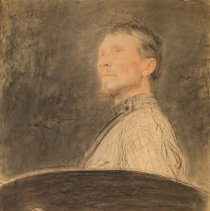
Ilya Repin was born in the town of Chugev in the Ukraine. He received early drawing instruction at the local school of mapmaking, Chugev being a military town. At the age of fourteen he began studying with a local icon painter, as well as with other painters in the area. After several years working at various art trades, he had earned enough to leave his home and enroll at the Imperial Academy of Art in St. Petersburg in 1863. There he received both an academic education in the liberal arts, and standard academic painting training, winning several awards for paintings such as The Angel of Death Smites the First-Born Egyptians. As a result of his rural origins, he also became deeply attuned to the plight of the peasants and the working class. His 1873 painting depicting the excruciating labor of the Volga River barge haulers became a sensation and established him as a rising talent. The Academy funded his travel in Italy, and a stay in Paris from 1873 to 1876. In Paris he absorbed some of the ideas of the Impressionists, but these innovations affected him primarily in terms of his ability to occasionally use a lighter palette and brighter colors. In his mid-thirties he joined the Society of Traveling Exhibitions, sometimes translated as the Wanderers. These artists dedicated themselves to the cause of Russian national art, and throughout his long career Repin remained committed to subjects drawn from Russian history, or from contemporary events. His technique remained firmly rooted in tradition. He is considered the best painter of the nineteenth-century Russian realist school. Repin lived in St. Petersburg for most of his active years, producing dozens of large paintings, and at the same time teaching at the Academy. He knew many of the major figures within the Russian intelligentsia and artistic circles, and produced scores of portraits of these individuals. His sitters ranged from writers such as Leo Tolstoy and Ivan Turgenev, to composers such as Alexander Glazunov and Modest Mussorgsky, as well as scientists, statesmen and collectors. |
Role |
Artist |