Creator Record
Images

Metadata
Name |
Dana, Fra |
Dates & places of birth and death |
b. 1874 Terre Haute, IN d. 1948 Great Falls, MT |
Nationality |
American |
Notes |
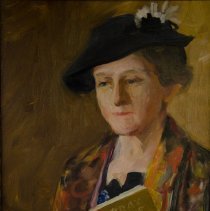
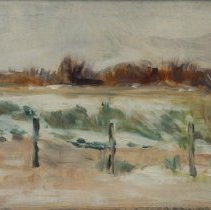
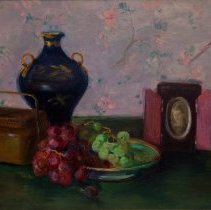
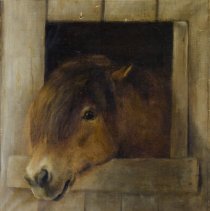
On Nov. 26, 1874, a girl named Fra Marie Broadwell was born into a well-to-do family in Terre Haute, Ind. After showing an early interest in art, Fra was sent off to study at the private Cincinnati Art Academy at the age of 16. After three years there, Fra ventured to New York City to study under William Merritt Chase, then considered the most important American artist and art instructor of the age (his Chase School of Art is now the Parsons New School for Design). Over the next few years, Fra would spend several periods studying with Chase and, along the way, serving at times as a model for the teacher. It was from Chase that the young painter established her own values in art. But while that much remained consistent, the rest of Fra's life had already taken a sharp turn by the time she fell under Chase's influence. In 1893, at age 19, Fra came to Wyoming to live with her mother, who had remarried after a divorce. The contrast between the cultured art world of New York City and the isolated rural life of late 19th century Wyoming proved a hard pill for Fra to swallow. "I'm sure she was kicking and screaming the entire way," said Hedquist. "She clearly wasn't one of those people who romanticized the rural West." Excerpts from Fra's journals evidence that she thought little of the place and its everyday denizens. "There are two cattle dealers here this week, a surveyor and a woman selling tombstones," she wrote in one entry. "For all of these people I have to make their beds and empty their slops and wait on them. How the spirit doth rebel. Especially at having to talk to them when they are not interesting." Soon enough, though, the young woman found a person who was interesting: Edwin Dana, a man 10 years her senior whose family owned the ranch adjacent to the one owned by Fra's stepfather. In 1896, the two married. Past accounts of Fra Dana's life have often asserted that, prior to the marriage, the couple penned a prenuptial agreement stating that Fra would be allowed to continue her art studies. Hedquist said such a document never in fact existed; however, what is clear is that Edwin supported his wife's passion for art, to the extent possible. The two would ultimately remain married for half a century, building a vast and successful ranching operation. Fra participated in all aspects of the operation: She castrated steers and branded calves, ran the books and kept the house. Yet always, art called to her. In one journal entry, Dana talks of being preoccupied by the birthday of the Spanish painter Diego Velasquez in virtually the same breath as she describes spaying dozens of heifers in a single morning. The entry ends on a note of despair: "This is life and the thoughts that I used to think were dreams. Beauty of any kind is a thing held cheap out here in this land of hard realities and the glaring sun and alkali. There are no nuances." *** So Fra Dana sought out those nuances through frequent travels. Hedquist said she has documented at least nine overseas trips taken by Dana in the early years of the 20th century. She traveled to Paris, where she visited with Gertrude Stein and saw the new works of Matisse and Picasso; she also ventured to Egypt, Ireland, Cuba and elsewhere. Fra and Edwin kept an apartment in New York City, where she became friends with the influential painter Alfred Maurer. Maurer employed Fra as a model for some of his work, and the two exchanged art. One of Maurer's works that Dana obtained was a portrait titled "Gabrielle," produced during Maurer's early Impressionist period. As part of the deal, Dana obtained the blue cape worn by the figure in the painting. Later, she employed that same cape in a self-portrait that has become one of her own best-loved works. Brandon Reintjes, curator of the Montana Museum of Art and Culture, said that the self-portrait bespeaks much about Dana's aspirations. "You can see this desire to embody the paintings and that life of sophisticated art in that portrait," he said. "She's wearing the same jacket and portraying herself reading on the window seat, engaged in an act of literature and culture." "You see that tendency in the subject matter of all of her own artworks," Reintjes added. "Her paintings are less about Montana than about some interior space of the mind where she's projecting her wants and desires about a sophisticated European culture onto her circumstances. She was really worldly and cultured, and felt somewhat inhibited living out in the middle of nowhere." Yet she stayed, and even settled to some degree. After suffering a nervous breakdown in New York in 1911, Dana cut back on her travels. New movements of art were afoot - Cubism, Expressionism, Fauvism, Futurism - and while she consumed all she could read and see about these new forms of art, Fra maintained her allegiance to the aesthetics and principles of Impressionism. Dana passed away December 1, 1948 after extensive communications with The University of Montana regarding her legacy. Her bequest of her own artworks as well as those by others is central to the richness of the MMAC Permanent Collection. Her donation included Japanese prints, prints by Honore Daumier and Jean Louis Forain and paintings by Joseph Henry Sharp, Alfred Maurer, WIlliam Merritt Chase, Douglas John Connah and others. |
Role |
Artist |